

Quick answer
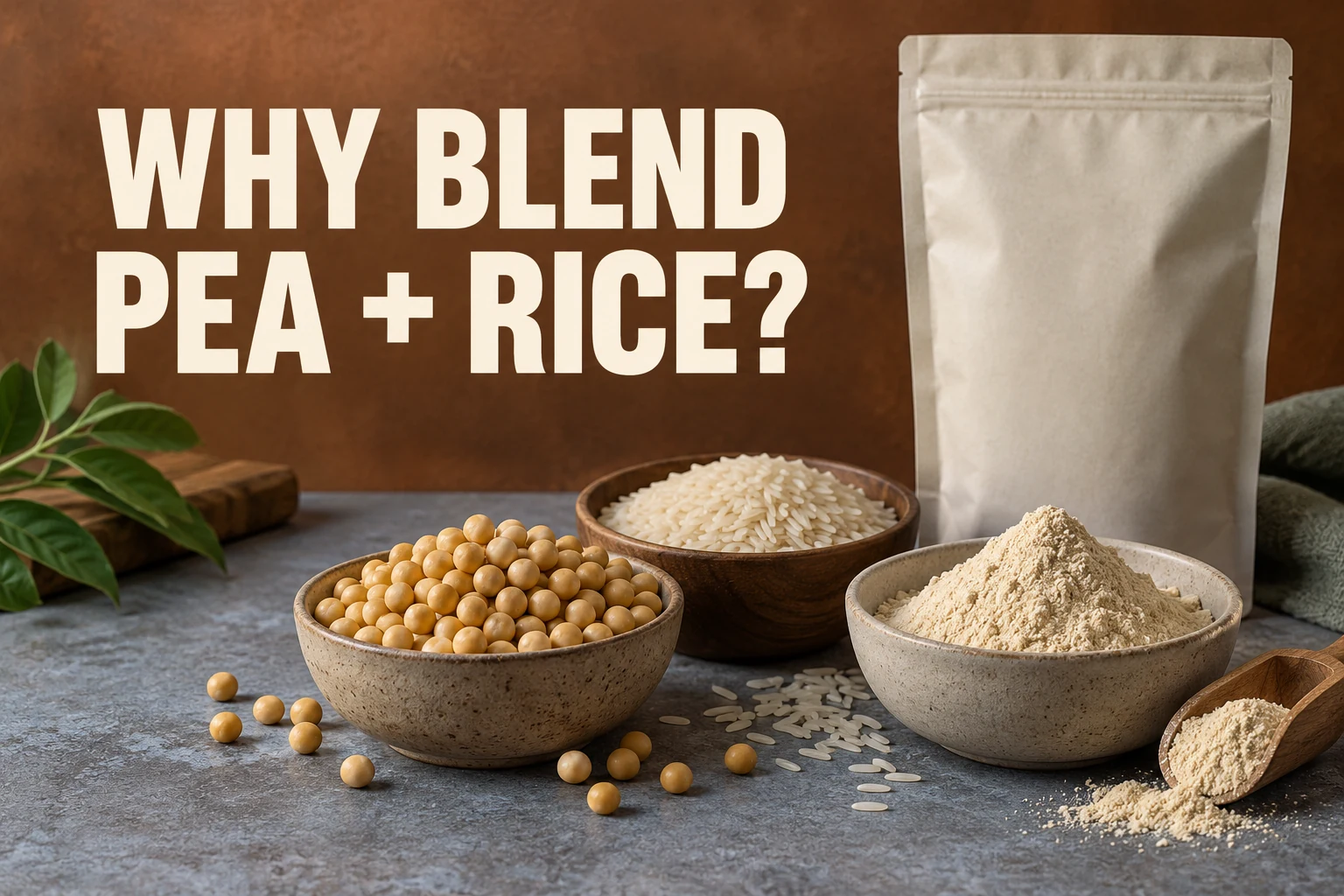
Pea and rice work together because their relative amino-acid strengths complement each other. A blend can support muscle gain when total protein and training are adequate. Soy isolate is another complete plant-based option if you tolerate soy.
The problem with single-source plant proteins
Most plant proteins are incomplete. They contain all nine essential amino acids, but one or more is present in quantities too low to support optimal muscle protein synthesis when that source is used exclusively.
Pea protein is low in methionine and cysteine. Rice protein is low in lysine. Either used alone requires compensating through the rest of the diet. Together, they cover each other's gaps almost completely.
Live comparison
Vegan Protein products
| Add to compare list | # | Retailer | Product | Flavour | Size | Servings | Protein per 100g | Calories per 25g protein | Price | Buy | More | |
|---|---|---|---|---|---|---|---|---|---|---|---|---|
| 1 | BulkSupplements |  veganBulkSupplementsPeanut Flour Protein Powder | – | 22.68kg | 454 | 50g | 217 | CA$584.00 | CA$1.287 | |||
| 2 | Canadian Protein |  veganCanadian ProteinBulk Vegan Protein | 10kg | 320 | 80g | 123 | CA$412.46 | CA$1.289 | ||||
| 3 | Canadian Protein |  veganCanadian ProteinPea Protein IsolateUnflavoured & Unsweetened | Unflavoured & Unsweetened | 2kg | 66.6 | 83.3g | 120 | CA$89.99 | CA$1.350 | |||
| 4 | Myprotein |  veganMyproteinPea Protein Isolate | 998g | 33.5 | 84g | 119 | CA$45.49 | CA$1.357 | ||||
| 5 | Canadian Protein | veganCanadian ProteinBulk Vegan Protein | 6kg | 192 | 80g | 123 | CA$263.98 | CA$1.375 | ||||
| 6 | Naked Nutrition |  veganNaked NutritionOrganic Brown Rice Protein Powder | – | 2.27kg | 75.6 | 83.3g | 120 | CA$106.28 | CA$1.406 | |||
| 7 | Canadian Protein | veganCanadian ProteinPea Protein IsolateUnflavoured & Unsweetened | Unflavoured & Unsweetened | 1kg | 33.3 | 83.3g | 120 | CA$49.99 | CA$1.500 | |||
| 8 | LEANFIT | – | 715g | 22.3 | 77.8g | 131 | CA$33.59 | CA$1.510 | ||||
| 9 | LEANFIT |  veganLEANFITPLANT-BASED PROTEIN & GREENS Vanilla 1.2kg | – | 1.2kg | 36.9 | 76.9g | 125 | CA$56.99 | CA$1.544 | |||
| 10 | Myprotein |  veganMyproteinVegan Protein BlendVegan Protein Blend 2.2lb | Vegan Protein Blend 2.2lb | 998g | 30.8 | 77.1g | 111 | CA$48.99 | CA$1.592 | |||
| 11 | LEANFIT |  veganLEANFITPLANT-BASED PROTEIN & GREENS Chocolate 579g | – | 579g | 16 | 69g | 138 | CA$25.59 | CA$1.601 | |||
| 12 | LEANFIT |  veganLEANFITPLANT-BASED PROTEIN & GREENS Vanilla 517g | – | 517g | 15.9 | 76.9g | 125 | CA$25.59 | CA$1.609 | |||
| 13 | LEANFIT |  veganLEANFITPLANT-BASED PROTEIN & GREENS Berry 533g | – | 533g | 15.8 | 74.1g | 125 | CA$25.59 | CA$1.620 | |||
| 14 | Canadian Protein |  veganCanadian ProteinOrganic Brown Rice Protein PowderUnflavoured & Unsweetened | Unflavoured & Unsweetened | 2kg | 64 | 80g | 123 | CA$109.99 | CA$1.719 | |||
| 15 | Canadian Protein |  veganCanadian ProteinVegan Protein | 2kg | 64 | 80g | 123 | CA$109.99 | CA$1.719 | ||||
| 16 | Myprotein |  veganMyproteinTHE Plant Protein | 1.15kg | 27.6 | 59.8g | 160 | CA$48.99 | CA$1.778 | ||||
| 17 | Myprotein | veganMyproteinTHE Plant ProteinVanilla Chai | Vanilla Chai | 1.12kg | 26.8 | 59.8g | 160 | CA$48.99 | CA$1.828 | |||
| 18 | Canadian Protein | veganCanadian ProteinOrganic Brown Rice Protein PowderUnflavoured & Unsweetened | Unflavoured & Unsweetened | 1kg | 32 | 80g | 123 | CA$59.99 | CA$1.875 | |||
| 19 | Canadian Protein | veganCanadian ProteinVegan Protein | 1kg | 32 | 80g | 123 | CA$59.99 | CA$1.875 | ||||
| 20 | LEANFIT |  veganLEANFITORGANIC PLANT-BASED PROTEIN Vanilla 1.5kg | – | 1.5kg | 37.1 | 61.8g | 143 | CA$69.99 | CA$1.888 | |||
| 21 | LEANFIT |  veganLEANFITORGANIC PLANT-BASED PROTEIN Vanilla 715g | – | 715g | 17.7 | 61.8g | 143 | CA$33.59 | CA$1.900 | |||
| 22 | PVL | 840g | 24.7 | 73.5g | 120 | CA$49.99 | CA$2.023 | |||||
| 23 | LEANFIT |  veganLEANFITORGANIC PLANT-BASED PROTEIN Chocolate 1.5kg | – | 1.5kg | 34.1 | 56.8g | 155 | CA$69.99 | CA$2.054 | |||
| 24 | LEANFIT |  veganLEANFITORGANIC PLANT-BASED PROTEIN Chocolate 715g | – | 715g | 16.2 | 56.8g | 155 | CA$33.59 | CA$2.068 | |||
| 25 | BulkSupplements |  veganBulkSupplementsPea Protein Powder | – | 1kg | 28 | 70g | 119 | CA$58.00 | CA$2.071 | |||
| 26 | BulkSupplements | veganBulkSupplementsPeanut Flour Protein Powder | – | 1kg | 20 | 50g | 217 | CA$51.00 | CA$2.550 | |||
| 27 | BulkSupplements | veganBulkSupplementsPeanut Flour Protein Powder | – | 500g | 10 | 50g | 217 | CA$42.00 | CA$4.200 | |||
| 28 | BulkSupplements | veganBulkSupplementsPeanut Flour Protein Powder | – | 250g | 5 | 50g | 217 | CA$34.00 | CA$6.800 | |||
| 29 | BulkSupplements | veganBulkSupplementsPeanut Flour Protein Powder | – | 100g | 2 | 50g | 217 | CA$31.00 | CA$15.500 |


Why pea and rice work so well together
The amino acid deficits of pea and rice protein are complementary in the most useful way possible. Pea protein is high in lysine, the amino acid that rice lacks, and rice protein is relatively high in methionine and cysteine, the amino acids that pea lacks.
Blending the two in a roughly 70:30 or 60:40 pea-to-rice ratio produces a combined amino acid profile that closely mirrors whey protein. This is why pea and rice blends consistently outperform single-source plant proteins in muscle-building research.
Leucine content of the blend
Leucine, the key amino acid for triggering muscle protein synthesis, is present at around 8% in pea protein and around 6.5-7% in rice protein. A 70:30 pea-to-rice blend has a leucine content of roughly 7.5-8%, compared to whey's 10-11%.
This small gap is closed by using a slightly larger serving size. A 30-35g serving of a pea and rice blend delivers approximately the same leucine dose as a 25g serving of whey, which is sufficient to maximally stimulate muscle protein synthesis.
How to read a vegan protein label
When buying a pea and rice blend, look for the ratio on the label. A product that lists pea protein first with rice protein as a secondary ingredient is weighted toward pea, which is the stronger of the two for leucine and lysine content.
Check total protein per 100g. The blend should deliver at least 70g. Products with additional ingredients like digestive enzymes, added leucine, or vitamin blends may cost more but can offer a more complete nutritional profile for athletes with higher recovery demands.

Cheapest Vegan Protein
Peanut Flour Protein Powder
BulkSupplements · 50 lbs
Pros
- The declared portion supplies 4g fibre, alongside its protein
- 37.8% cheaper per 25g protein than the median of 31 other vegan product families in this comparison
Cons
- At 50% protein, a 25g protein portion supplies about 217 kcal, rather than the roughly 100 kcal supplied by the protein itself
Pea and rice vs soy
Soy protein is the closest plant equivalent to whey in terms of amino acid completeness and digestibility. A well-formulated pea and rice blend approaches soy on both measures while avoiding the soy allergen.
Both soy and pea-and-rice blends can be useful. The better fit depends on the amount of protein, taste, price and your allergies. A pea-based powder should not be assumed safe for everyone with a peanut allergy.
Watch what buyers found
Hands-on opinions
Why Combining Pea and Rice Protein Can Build Muscle Mass | Nutrition Coach Explains| Naked Nutrition
Naked Nutrition
A topic-specific video selected for additional practical context on Pea and Rice Protein Blend: A Smarter Buyer's Guide for 2026.
Frequently asked questions
What ratio of pea to rice protein is best?+
There is no single ideal ratio for every powder. Both sources need to contribute meaningfully; the total protein content and any published amino-acid profile are more useful than a blend name alone.
Is pea and rice protein better than whey?+
Not categorically. A well-formulated pea and rice blend is comparable to whey for muscle building when serving sizes account for the lower leucine density. Whey remains slightly more efficient per gram, but the practical difference for most people is small.
Do I need a pea and rice blend or can I buy them separately?+
Pre-blended products are more convenient and typically priced similarly to buying separately. Buying separate pea and rice protein powders allows you to control the ratio but requires mixing and storage of two products.